
What's New?
September 2025
Our new book that provides a guide for students success at Penn State, title A student guide to success at Penn State, is available through [this link].
February 2021
Our open access book, Building Better Interfaces for Remote Autonomous Systems: An Introduction for Systems Engineers (e.g., remotely controlled vehicles), has been published open access, and is available open access (directly as a PDF) through [this link].
January 2021
Our book, Skills to Obstruct Pandemics: How to protect yourself and your community from COVID-19 and similar infections based on the tutor, has been published.
October 2020
Fredrick Ryans, graduate student in the lab and valued colleage, unexpectedly passed away after a brief stay in the hospital. His family's GoFundMe for his funeral.
May 2020
Skills To Obstruct Pandemics tutor has been released. It is a comprehensive tutor for skills to deal with the COVID-19 pandemic. Book to follow!
January 2018
Caffeinezone has now over 100k downloads!Three books by Paul Thagard on cognitive science published in the OUP series: Brain-mind, Mind-society, and Natural philosophy.
Read the Forewords here.
Links to the numerous and wonderful cultural references in Ch. 9, Natural Philosophy.
November 2017
Foundations for designing user-centered systems published in Chinese with Chinese Academy of Sciences. January 2017
New book by Tani to come out in OUP series on embedded cognition.November 2016
ICCM 2016 Special issue in Topics in Cognitive Science in press.July 2016
ICCM 2016 Conference at Penn State.. Proceedings now online. April 2016
Project to build tutor for AF nurses started using D2P
April 2016
Tutorial on modeling at FIERCES on BICA in Moscow.February 2016
Seminar talk at U of Buffalo.
January 2016
NSF will provide travel support to students to go to ICCM. See the ICCM site for details.
Simple dieting aid being tested in a trial in Iowa.
December 2015
Running behavioral studies now on KindleOctober 2015
Foundations for Designing User-Centered Systems may be finished being translated into Chinese this month.
Talk at Carleton U. and PhD exam at Carleton mid-October.
July 2015
ONR project to study tutoring coming in, and will need RAs.
July 2014
"Running behavioral studies with human participants", was given as a tutorial at the Cognitive Science conference, and the slides as simple teaching support are available.
Gave a tutorial on "From keystrokes to cognitive models" was given at the International summer school on cognitive science in Sofia, Bulgaria.
May 2014
Foundations for Designing User-Centered systems has been published, may be available in your library through Springer Link, and some simple teaching support is available.
March 2013
CaffeineZone has been profiled in Oprah's "O" magazine's April issue (p. 110) on using caffeine more effectively. Now on newstands!
December 2012
Our tutor for teaching battlefield trauma has been released to alpha testers.
November 2012
The book with practical advice on how to run studies has been published by Sage. On the web page for it, you can order an examination copy (Request Review Copy, an image), if you can use it in your teaching.
July-August 2012
Tutorials on how to run studies, a practical guide, given at the Cognitive Science Conference in Japan and at the Institute for Software, Chinese Academy of Sciences. These teaching materials are available.
December 2012
I gave a talk at Wright Patt in the Chief Scientist's Lecture series about risk driven design. There is an exciting and growing group there. Talk materials on the recent talks page.
December 2012
The first issue of IEEE Systems, Man and Cybernetics: Humans and Systems, a new journal, has just been published. It offers a new outlet for simulations of humans. As an associate editor, I'm charged to help recruit (and evaluate) papers for the journal.
25 July 2012
Our paper on Cognitive Java Agent Construction Kit (CoJACK) came out in Biologically Inspired Cogntive Architectures as the lead article in the first issue.
March 2012
Students in the lab were awarded to conference paper awards at the BRIMS conference. Chris Dancy got the best paper and best student paper award, and Changkun Zhao got an recommended reading list award. It also got an IST press release.
2 December 2008
Work using High performance computing appeared in the National Supercomputing Center's magazine, "Modeling the mind" Glantz, E. J., & Ritter, F. E. (2025). A student guide to success at Penn State. LuLu.com [
 Skills to Obstruct Pandemics: How to protect yourself and your community from COVID-19 and related infections. Ritter, F. E., Clase, A. C., Harvill, S. L., Yeh, M. K.-C., Joseph, R. E., Oury, J. J., Oury, J. D., Fenstermacher, A., Brener, M., & James, J. J. (2020). [
 Building Better Interfaces for Remote Autonomous Systems
An Introduction for Systems Engineers. Oury, J. D., & Ritter, F. E. (2021). [
Building Better Interfaces for Remote Autonomous Systems
An Introduction for Systems Engineers. Oury, J. D., & Ritter, F. E. (2021). [ Proceedings of ICCM 2016, 14th International Conference on Cognitive Modeling (ICCM 2016). Reitter, D., & Ritter, F. E. (Eds.). (2017).
  Foundations for user-centered Design: What system designers need to know about people, Ritter, Baxter, & Churchill (2014), Springer. We also have a small web site of supplemental materials
 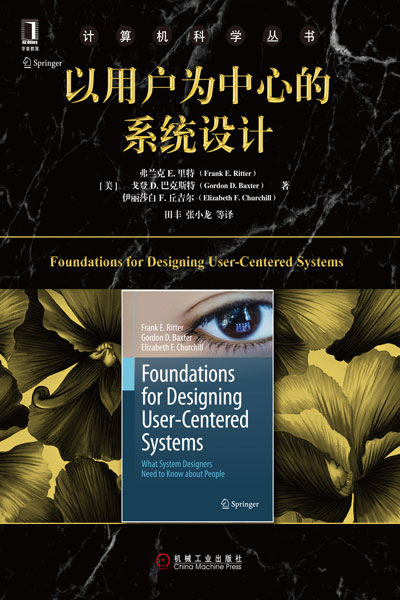 Foundations for user-centered Design: What system designers need to know about people, Ritter, Baxter, & Churchill (2014), translated by researchers as the Chinese Academy of Science (2017), led by Prof. Xiaolong Zhang.
  Running behavioral studies with human participants: A practical guide, Ritter, Kim, Morgan, & Carlson (2013), Sage. We also have a small web site of supplemental materials
  Ritter, F. E., Nerb, J., O'Shea, T., & Lehtinen, E. (Eds.), (2007). New York, NY: Oxford University Press. This book describes order effects (e.g., ab vs. ba) in human and machine learners. It arose out of a European Science Foundation project to study learning in humans with applications to education and technology.
  Ritter, F. E. [member], Committee on Human-System Design Support for Changing Technology. (2007). Human-system integration in the system development process: A new look. Richard W. Pew and Anne S. Mavor (eds.). National Research Council, National Academy Press. Washington, DC. This book describes a risk-driven approach to large system design. This provides a role for human-factors and HCI issues, and it proposes several research projects in these areas, some related to the central role that models of users should provide in this process.
 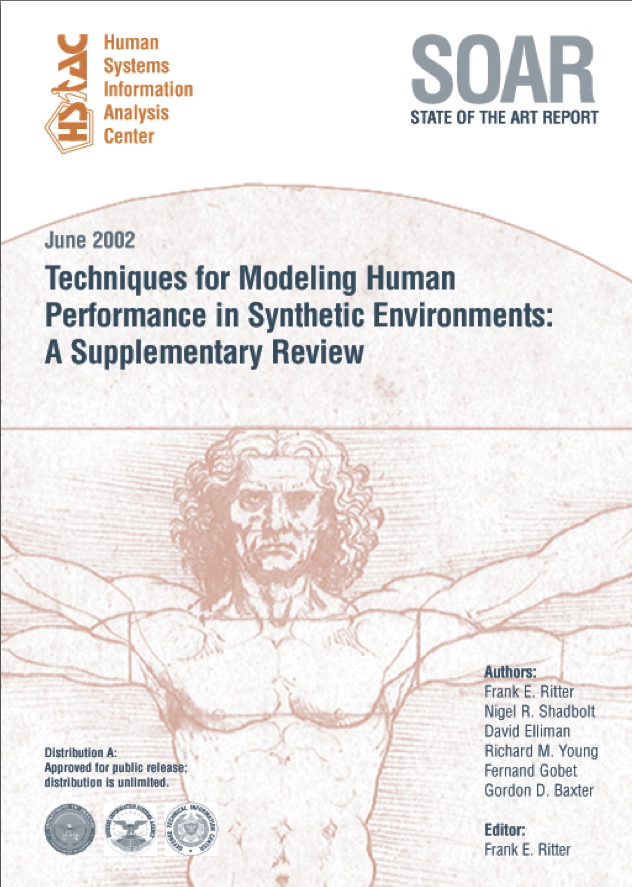 Ritter, F. E., Shadbolt, N. R., Elliman, D., Young, R., Gobet, F., & Baxter, G. D. (2003). Wright- Patterson Air Force Base, OH: Human Systems Information Analysis Center. This book is a reply to Pew & Mavor funded by the UK government, and it includes about 30 projects in this area, many of which we have been working on. Some have appeared as program announcements in the UK (intentional), and in the US (we don't know the casuality).
  Ritter, F. E., & Young, R. M. (Eds.). (1998). Thrumpton (UK): Nottingham University Press. Now out of print, but available